Which Payments Companies Are Using Stablecoin Settlement and Why?
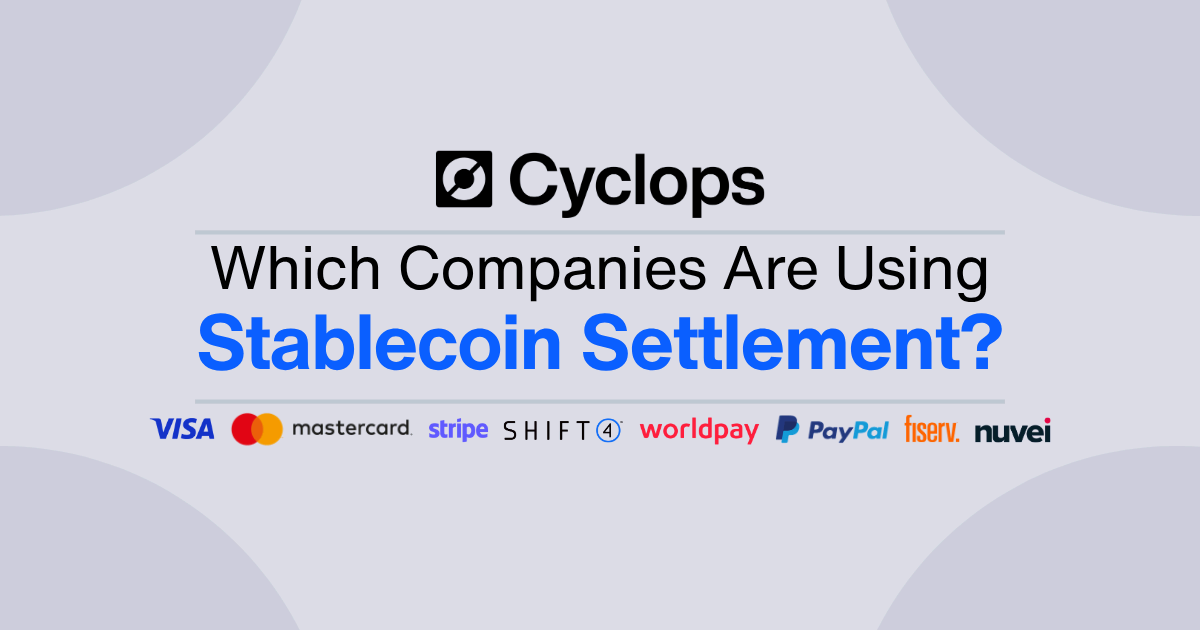
The payments companies that moved early, what they built and what it means for the rest of the industry.
The debate about whether stablecoins belong in payments infrastructure is over. What's worth paying attention to now is who is building what, how fast they're attacking each problem area and at what scale they intend to deploy the solutions across their systems. Here's an overview of today's top stablecoin offerings in the payments ecosystem in 2026.
Visa
Visa has been settling transactions in stablecoins since 2023 — longer than most people realize. The company's stablecoin settlement pilot now supports nine blockchains and has reached a $7 billion annualized run rate, up 50% quarter over quarter. That growth trajectory is the story. Visa isn't experimenting, it's operationalizing, expanding to new chains and new corridors every quarter while its volume compounds.
Mastercard
Mastercard made its biggest stablecoin bet yet in March 2026. The company announced a definitive agreement to acquire BVNK for up to $1.8 billion. The deal gives Mastercard end-to-end stablecoin infrastructure across 130+ countries and the ability to connect traditional payment rails with on-chain settlement for processors, acquirers and fintechs.
Stripe
In February 2025, Stripe completed its $1.1 billion acquisition of Bridge, the stablecoin infrastructure platform. The move was immediate and aggressive. Within months, Stripe launched Stablecoin Financial Accounts — allowing businesses in 101 countries to hold balances in dollar-backed stablecoins, receive funds on both crypto and fiat rails and send stablecoins globally. Stripe's approach is to make stablecoins completely invisible to the end user. Merchants see their dashboard, customers see a normal checkout and the stablecoin rails handle everything behind the scenes.
Shift4
Shift4 took a merchant-first approach, and the team behind that build is now the team behind Cyclops. In late 2025, Shift4 launched stablecoin settlement for hundreds of thousands of merchants globally, supporting USDC, USDT, EURC and DAI across networks including Ethereum, Solana, Stellar, Polygon and Base. Merchants toggle it on in their dashboard — no new vendor, no additional integration, no blockchain knowledge required. The Cyclops founders spent four years building this at Shift4, and what they learned in the process is now put into every product decision at Cyclops.
Worldpay, Checkout.com & Nuvei
Before the headlines, these three were already moving. Worldpay, Checkout.com and Nuvei were among the earliest large PSPs to support stablecoin settlement, moving before the Stripe acquisition and the Mastercard deal made front-page news. They saw the trend early, built the capability and are now processing real settlement volume. Their early movement is worth noting precisely because it happened without the headline acquisitions and billion-dollar bets — proof that stablecoin settlement doesn't require a blockbuster deal to get off the ground.
PayPal & Fiserv
PayPal and Fiserv went a step further than settlement — they issued their own stablecoins. PayPal's PYUSD is issued in partnership with Paxos, and Fiserv's FIUSD is issued in partnership with both Paxos and Circle — giving these companies something most of the industry doesn't have: control over the supply, spread and full stablecoin stack. Fiserv deepened the commitment further through a partnership with Mastercard, integrating FIUSD across Mastercard's global network.
What This Means for PSPs Still Deciding
Every company above made a deliberate choice to move before the market fully arrived. None of them waited for perfect regulatory clarity, complete market demand or a fully mature infrastructure ecosystem. They built, and the results speak for themselves.
The opportunity is still just as real for the payments companies that haven't moved yet. The infrastructure exists, the regulatory frameworks are in place and the demand from merchants is there. What's changed is that the bar for execution is higher, and having the right infrastructure partner makes all the difference in getting there quickly.
That's exactly what Cyclops was built for. Purpose-built stablecoin infrastructure for payments companies, by the team that built it at Shift4 — so you don't have to figure it out the hard way.
Talk to the Cyclops team about your stablecoin strategy.