The On and Off Ramp Problem in Stablecoin Payments
Why the entry and exit points are where stablecoin adoption can stall and what payments companies need to solve it.
Cyclops built our stablecoin platform for payments companies, and one of the most consistent conversations we have with PSPs evaluating stablecoin infrastructure is about on/off ramps. Not the stablecoin itself. Not the blockchain. The on/off ramps. Because that is where the practical reality of deploying stablecoin rails either comes together or falls apart.
What on/off ramps actually are
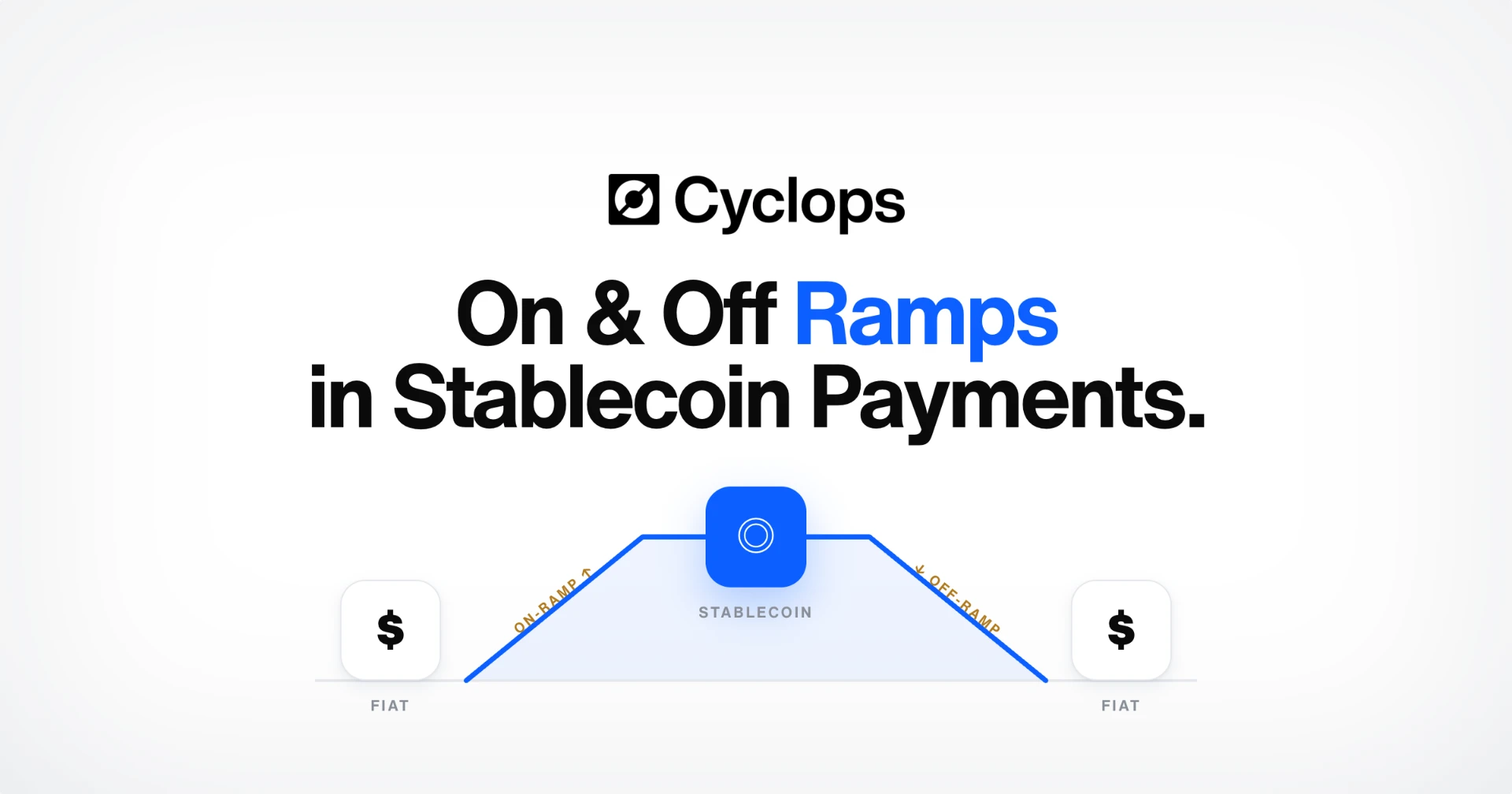
In stablecoin payments, the on-ramp is the conversion of fiat currency into a stablecoin at the point of entry. The off-ramp is the conversion of a stablecoin back to fiat currency at the point of exit. Between the two, stablecoin rails handle the settlement. The result is the stablecoin sandwich: fiat in, stablecoin rails in the middle, fiat out. Neither the merchant nor the customer sees or touches a stablecoin. They just experience faster, cheaper and more reliable payments.
The on-chain part of that process is largely solved. As a16z noted in their 2026 payments trends report, you can send a stablecoin in less than a second for less than a cent. What remains the harder problem for most payments companies is what sits on either side: reliably connecting those digital dollars to the fiat rails that merchants and customers actually use.
Why this is the hard part
The on and off ramp layers are where the complexity lives. Stablecoins are increasingly becoming central to global payments but remain trapped in a circular cryptocurrency economy unless users can easily and reliably exit into traditional financial systems. Off-ramping requires coordination with regulated banks, compliance checks and legacy systems that were built for a different era.
For PSPs, that friction shows up in very specific ways. Not every off-ramp provider covers every corridor. Not every provider handles compliance consistently across jurisdictions. Liquidity depth varies dramatically between markets, with the same stablecoin trading across dozens of venues each with different pricing and fiat access conditions. As FinTech Weekly reported, for businesses that need consistent high-volume flows across most corridors, the infrastructure either does not exist at a reasonable cost or requires stitching together multiple counterparties with inconsistent compliance standards.
That means a PSP attempting to build stablecoin capabilities independently typically ends up managing separate on-ramp and off-ramp providers, compliance screening across each and banking relationships in every destination market. The fragmentation that stablecoin rails are supposed to eliminate often just moves to a different part of the stack.
What it means for merchants
Merchants don't necessarily want stablecoins. They want their settlement funds, in their local currency, as fast as possible. The entire value proposition of stablecoin rails for PSPs depends on the off-ramp working reliably and cost-efficiently because that is the last step between stablecoin settlement and the fiat that actually lands in a merchant's account.
The BIS has noted that a stablecoin arrangement can facilitate cross-border payments only if there are convenient and affordable arrangements for converting the stablecoin into the currencies of the jurisdictions involved. A stablecoin settlement that works well on-chain but delivers unreliable or expensive fiat conversion at the exit point does not deliver the benefit it promised.
What solving it looks like
The answer for most PSPs is a single integration that handles both ends reliably. Building on/off ramp infrastructure independently across multiple corridors means taking on compliance obligations, local banking relationships and AML frameworks in every jurisdiction. For most payments companies, that overhead outweighs the benefit.
Cyclops was built to solve exactly this. Our platform handles the full flow: fiat on-ramp, on-chain settlement and fiat off-ramp, across corridors, through a single integration. Payments companies do not manage separate providers for each leg or maintain local banking relationships in every destination market. The compliance framework, the liquidity and the fiat conversion are all handled within the platform. The PSP initiates the flow in fiat. The merchant receives fiat. The stablecoin rails do the work in the middle, invisibly.
That is what makes stablecoin infrastructure genuinely viable for payments companies at scale — not just the on-chain part, but the complete flow from fiat in to fiat out, handled reliably across every corridor the payments company operates in.