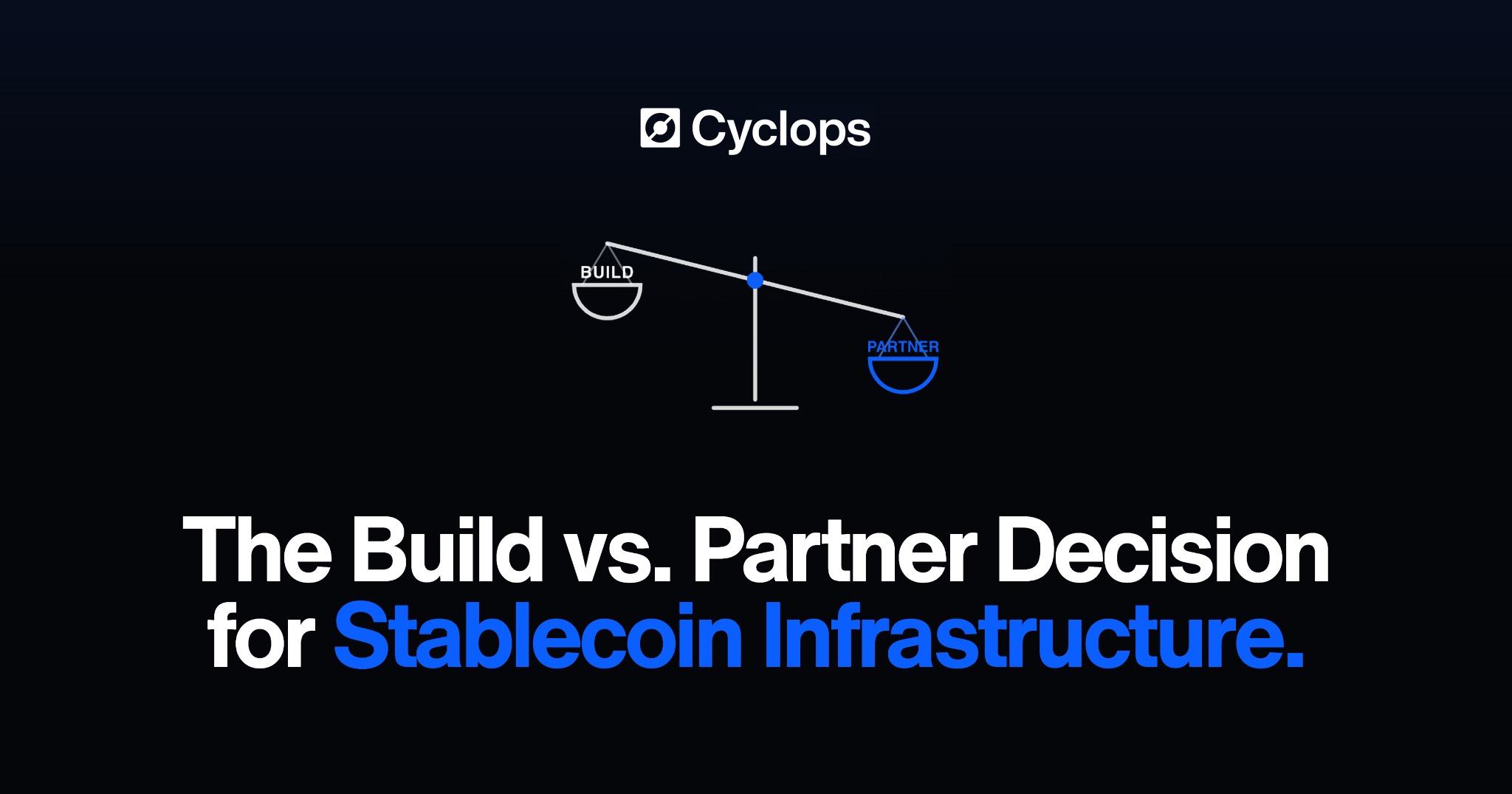
The Build vs. Partner Decision for Stablecoin Infrastructure
How long does it take your payments company to build and ramp stablecoin products? One decision changes everything: your partner(s).
Cyclops was built exclusively for payments companies. Before creating Cyclops, we spent years building stablecoin offerings at Shift4. Our payments clients ask themselves the same question we asked ourselves at every turn while building Shift4's ecosystem: "What should we build ourselves, and when should we work with partners?"
It's the same infrastructure decision that drives all platform development. If you build it, you get exactly what you want...right? We spent four years testing this theory — across pay ins, settlement and payout use cases. What we learned along the way was that things that appeared simple were not. From choosing the right parts, to contracting, to integrating, to orchestrating — the process was not only difficult but time-consuming and costly. Most PSPs discover the complexity of stablecoin infrastructure through years of trial and error. Building, licensing, banking and compliance pivots compound into delays and lost revenue. A partner who handles all of this, across every layer of the stack and every global corridor, can mean getting to market years earlier than competitors and saving millions in development costs.
The two layers that look like one
There are two distinct layers in stablecoin infrastructure, and they look similar from the outside but are almost nothing alike in terms of what they require.
The visible layer is the one everyone pictures. Add USDC or USDT as a checkout option. Pick the chains you'll support. Spin up wallets for merchants. Plug in fiat conversion on either end. A capable engineering team can scope this work in a sprint and describe it cleanly. It looks like a typical integration project.
Then there's the operational layer. KYB/KYC, sanctions screening, liquidity, custody, monitoring across multiple chains, reconciliation and reporting across jurisdictions. Each piece requires specialized expertise most PSP engineering teams don't have and most internal roadmaps don't account for. And underneath all of it sits the piece that actually decides whether "build" is even a choice: licensing and banking. Money transmitter licenses, banking partnerships and reserve arrangements aren't things an engineering team can sprint through. They take specialized compliance functions many payments companies haven't built, banking relationships that haven't been established and timelines measured in quarters, not sprints. This is where the build vs. partner decision actually gets made, because it's where the cost of building is highest, the timeline is longest and the risk of getting it wrong is fatal rather than technical.
We know because we lived it
Before founding Cyclops, our team spent four years building stablecoin infrastructure from inside Shift4 — one of the world's largest payment processors. We personally managed the vendor sprawl, the broken integrations and the compromises that fragmentation forces on you when you're trying to make generalist infrastructure work for a payments use case it wasn't designed for.
There is no good reason it should have taken the combination of previous crypto founders, a dedicated in-house product and engineering team, numerous infrastructure partners and years of work to make it happen. That experience is the direct foundation of what Cyclops builds today.
What building actually requires
The capital expenditure required to build stablecoin infrastructure independently is significant, and that's before ongoing operations, reserves and custody are factored in. The timeline from decision to first live transaction typically runs six months to well over a year, and that timeline assumes licensing and banking are already in place, which, for most payments companies, they aren't. Getting licensed as a money transmitter for virtual currency across the jurisdictions a payments company actually operates in, and finding banking partners willing to support stablecoin activity, can take as long as the technical build itself, sometimes longer. And the ongoing maintenance load is heavy: blockchain ecosystems evolve quickly, regulatory frameworks shift across jurisdictions and every new corridor or stablecoin requires new integration work, compliance review and, in some cases, new licensing.
Put simply: for most payments companies, "build" is never a clean second option sitting next to "partner." It's a multi-year, multi-function undertaking that touches engineering, compliance, legal and banking all at once, and that most organizations aren't structured to take on while also running their core business.
The payments companies that have moved fastest on stablecoin infrastructure, and are now processing volume across the payments industry's leading platforms, didn't get there by building everything from scratch. They got there by finding the right partners and moving.
Why the window is narrowing
According to industry analysis, PSPs operating in cross-border B2B payments, payroll or treasury services without a credible stablecoin strategy in their 2026 to 2027 roadmap are already falling behind. Stablecoins are shifting from a competitive differentiator to table stakes in certain corridors faster than most organizations are planning for. The GENIUS Act's implementing rules are moving through finalization and MiCA's transition period ended July 1 with no extensions. The regulatory frameworks are being set.
Industry analysts and payments-focused investors are citing a 12 to 24 month window for PSPs to make their stablecoin infrastructure decisions before the market consolidates around a smaller number of trusted platforms. The PSPs that move now build early-mover advantages. Those that wait will integrate whatever the market has already standardized around.
What partnering looks like done right
Partnering on stablecoin infrastructure doesn't mean handing off ownership or accepting a generic solution. It means finding a platform that was purpose-built for your specific use case, one that understands how payments companies actually operate.
The right infrastructure partner handles the operational layer. Custody, compliance, liquidity, reconciliation, corridor coverage across 150+ countries, so that the payments company can focus on the product their merchants see. 79% of financial institutions plan to leverage a third-party technology partner for their stablecoin infrastructure buildout. The companies that have moved fastest understand that the goal isn't to own every layer of the stack. The goal is to get to market, win merchant relationships and build scale before the window closes.
How Cyclops solves this
Cyclops built the platform that ends the fragmentation problem. There are hundreds of providers solving individual pieces of the stablecoin puzzle — wallets, ramps, licensing, settlement, FX. Individually, many of them are excellent. But a payments company that tries to assemble those pieces itself ends up managing multiple vendor relationships, redundant compliance reviews and months of integration work — all while running a business with thousands of employees and countless other priorities.
Cyclops identifies the best solution for every layer of the stack and orchestrates them into a single platform, accessible through one API. We build what doesn't exist for the payments use case and connect what already works. Where other platforms hand a client a toolkit and say build it, we build it with them and for them. One relationship. One integration. The full stack.