The Hidden Cost of FX Routing
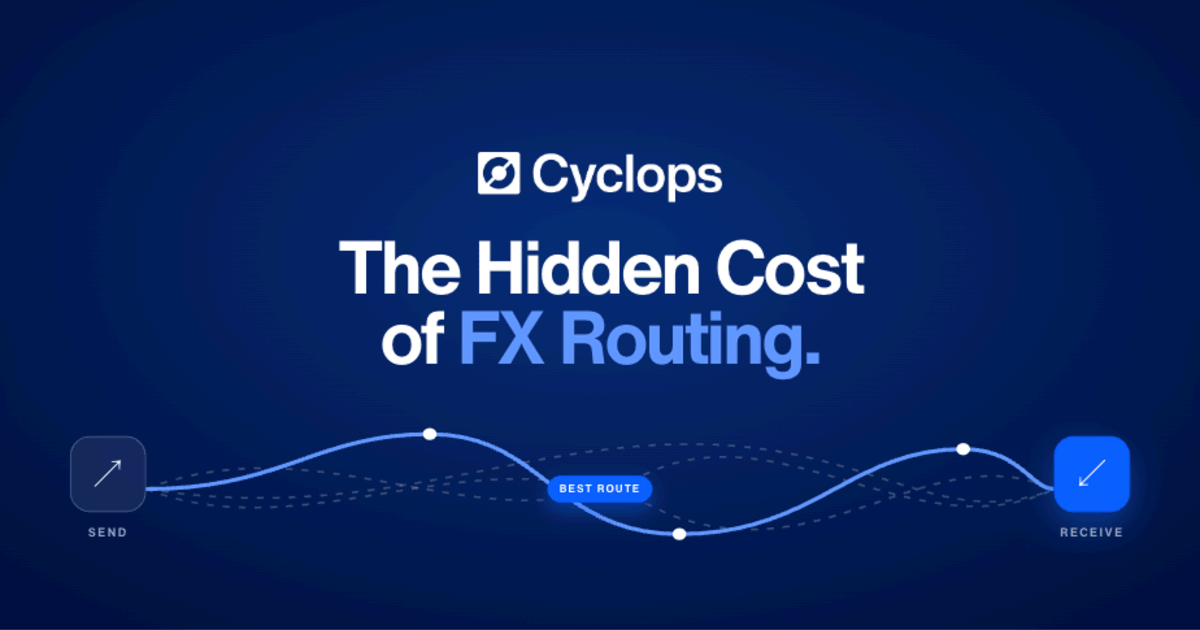
Depending on a single-provider FX partner is expensive for payments companies running cross-border flows. Here's what transparent routing can look like.
Cyclops built our stablecoin platform, connecting all the best partners for payments companies into a single API.
FX pricing is an area where we consistently see a gap between what payments companies think they're paying and what they're actually paying.
When it comes to FX for stablecoins, you can't just look at whether stablecoin rails are cheaper than traditional banking. They often are. But this is only part of the bigger picture. The more important question for PSPs running cross-border operations at scale is: are you getting a competitive rate within stablecoin rails, or are hidden spreads diminishing that advantage?
The spread you don't see
When evaluating stablecoin infrastructure, most payments companies focus on the headline fee. That's the number that gets quoted, negotiated and signed. What's harder to see is the FX spread embedded in every conversion along the way. When a payment moves through a single stablecoin infrastructure provider across a cross-border corridor, the cost of converting between currencies is largely determined by that provider's liquidity relationships, their margins and how much competition they face on that specific corridor. In liquid, well-established corridors like the US to Europe, spreads tend to be tight because competition is real. In less liquid corridors, the spread a single provider charges can vary significantly from what the broader market would offer. Industry analysis consistently shows that once you account for network fees, FX spread and off-ramp fees, the all-in cost of a stablecoin payment can end up running above the headline rate depending on the provider and corridor.
Why corridor matters
The spread problem is not uniform across markets. In well-traded corridors, the best available rate and the rate from a single fixed provider tend to be close. The deeper the liquidity, the tighter the spread. But in corridors where liquidity is thinner, the gap between the best available rate and a single provider's rate widens significantly. According to the IMF's 2026 working paper on stablecoin FX markets, price gaps between acquiring dollar exposure via stablecoins and via traditional FX markets vary substantially across currencies and corridors, with emerging market corridors showing the widest dispersion. A PSP routing through a single provider in one of these markets has no visibility into whether they're getting a competitive rate or subsidizing their provider's margin.
The same pattern shows up in flows that look straightforward on paper. FX conversion between major currencies like USD to EUR or USD to GBP can carry embedded costs that compound across transaction volume when routed through a single provider without comparison or optimization. Those costs rarely appear as a line item. They show up quietly in the overall cost of running the operation.
Emerging market corridors
This issue matters most in the corridors where stablecoin rails deliver the most value. US to Latin America, Europe to Africa, cross-border flows into Southeast Asia — these are markets where stablecoin adoption is highest, where traditional FX infrastructure is most expensive and where, counterintuitively, spread variance between providers is also highest. Chainalysis data confirms that stablecoin adoption in Sub-Saharan Africa and Latin America is driven primarily by limited access to competitive dollar liquidity through traditional banking. Stablecoins improve that access significantly. But a PSP routing through a single provider in these corridors without visibility into pricing is still leaving money on the table, just through a different mechanism than before.
Built-in redundancy and competition
Cyclops solves the single-provider dependency problem, without having to build your own multi-provider infrastructure.
Building your own system introduces vendor management overhead, compliance considerations and operational complexity that often outweigh the cost savings.
The better model is a single integration that handles routing optimization on your behalf with pricing that doesn't bury margins in the conversion. Cyclops takes a straightforward approach to FX pricing. Rather than variable corridor-by-corridor rates that shift based on liquidity or provider margin, we offer consistent, transparent pricing and handle the routing optimization ourselves. Payments companies know what they're paying. There are no hidden spreads at the conversion layer. And because we optimize for the best available path across corridors, the cost reflects the actual market rather than whatever a single provider decides to charge for a given corridor on any given day.
What this means for payments companies
Cyclops built our platform to give payments companies visibility and control over FX costs, not just at the headline level but across every conversion in the flow. For PSPs running cross-border operations at scale, that transparency is the difference between a reliable cost structure and one that chips away at margins across every corridor.