Blockchain Basics for the Payments Industry
The concepts and buzzwords that keep coming up in stablecoin conversations.
If you work in payments right now, you're hearing a lot of blockchain terminology. Settlement on-chain. Transaction finality. Wallets. Stablecoin rails. These terms come up in every stablecoin conversation, every industry conference and every earnings call from payments giants. Here's what each one actually changes for payments companies, without the technical detour.
Blockchain
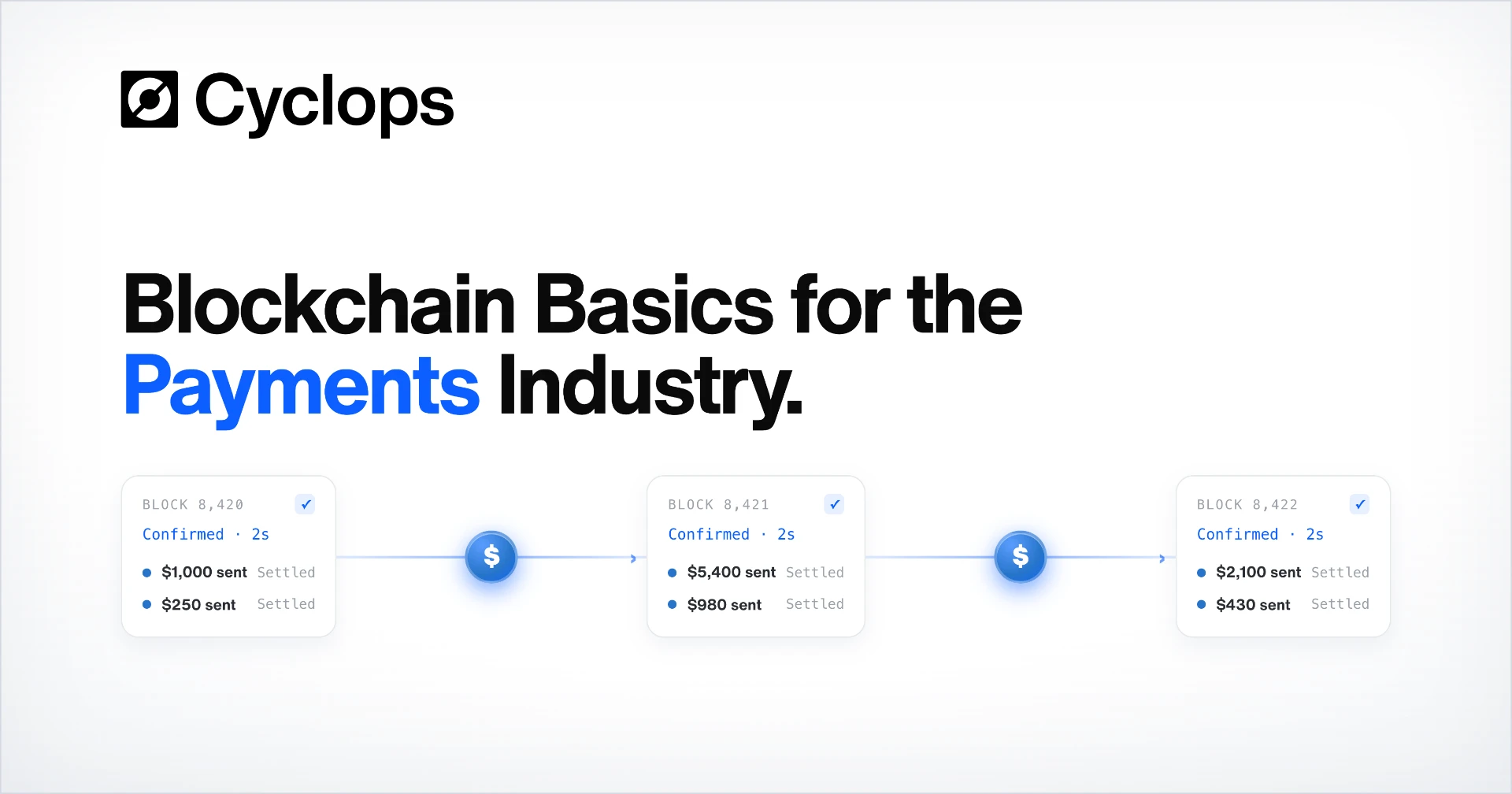
A blockchain is a shared, real-time record of transactions that no single institution owns or controls. For payments companies, the relevant point isn't the technology, it's what it replaces: a chain of banks each keeping their own version of a transaction, reconciling against each other after the fact, often through batch processes that only run at certain hours. On a blockchain, settlement happens once, and every party sees the same record instantly. No reconciliation gap, no waiting for a nightly batch to confirm what already happened. That's the shift everything else in this list follows from.
On-chain settlement
"Settling on-chain" means the transaction is finalized directly on a blockchain rather than routed through a correspondent bank. In practice, that's the difference between a payment that clears in seconds, any time of day, and one that can take one to five business days to settle depending on the corridor. For a PSP running cross-border flows, that's working capital sitting idle for days instead of being available same-day, and it's capital that has to be planned around: reserves held, cash flow forecasted, contingencies built in for a delay that on-chain settlement simply removes from the equation.
Transaction finality
On card and bank rails, a settled transaction can still be reversed, through a chargeback, a dispute or a recall. That reversal risk is why PSPs hold reserves, build fraud tooling and eat chargeback losses as a cost of doing business, and why underwriting a new merchant means pricing in some amount of expected dispute volume. On a blockchain, once a transaction is confirmed, there's no reversal mechanism. It's final. That doesn't mean fraud disappears, it means the chargeback as a mechanism doesn't exist on that rail. The risk moves upstream, to onboarding and merchant vetting, rather than sitting in post-transaction dispute management, which reshapes where a PSP's fraud and risk resources actually need to go.
Wallets
A wallet is an address that sends and receives digital assets, functionally similar to an account number. What matters for a PSP isn't the cryptography behind it, it's that your merchants and end users never need to see or manage one directly. It sits behind your existing product, the way an ACH routing number sits behind a bank transfer today, invisible to the end user and only relevant to whoever's running the infrastructure underneath.
24/7 settlement
Card and bank rails run on business hours and cut-off times. Settlement pauses Friday afternoon and doesn't resume until Monday. Blockchain rails don't have cut-off times, so a payment initiated at 11pm on a Saturday settles the same as one initiated at 11am on a Tuesday. For PSPs, that means treasury and liquidity planning no longer has to work around a settlement calendar, and it means merchants waiting on a payout don't have to plan their own cash flow around your bank's holiday schedule either.
USDC, USDT and EURC
These are the three stablecoins PSPs encounter most often. USDC is issued by Circle and is US-regulated. USDT is issued by Tether and sees heavy usage in emerging markets. EURC is Circle's euro-pegged stablecoin, gaining relevance under MiCA. Which one a given corridor calls for depends on local regulatory frameworks and liquidity, not a universal default. Getting that right, corridor by corridor, is exactly the kind of decision a strong stablecoin partner should be optimizing on your behalf as you expand into new markets.
Putting it together
None of this requires a payments company to become a crypto company. The infrastructure layer (wallets, conversions, on-chain settlement mechanics) is meant to sit underneath the product a PSP already has, not replace it with something new to learn. What it does require is one partner who handles that layer end to end, instead of a patchwork of vendors for custody, conversion, compliance and settlement stitched together and maintained in-house. That's the problem Cyclops was purpose-built to solve for payments companies specifically: one partner, one API, no fragmentation, no need to become a crypto company to offer stablecoin rails.