The Stablecoin Sandwich
How stablecoins are improving payments without anyone noticing.
The best infrastructure is the kind nobody sees. When you send an email, you don't think about how it's getting to the person's inbox. When you tap your card, you don't think about the mechanics behind it. The technology works, and that's all that matters.
Stablecoins are following the same path. Cyclops built our stablecoin platform for payments companies to work exactly this way — invisible infrastructure that delivers better outcomes without asking merchants or customers to change anything. The payments companies deploying stablecoins most effectively aren't asking their merchants to learn anything new or asking their customers to change how they pay. The experience is the same. The outcome is just better. Faster settlement, lower costs and global reach that traditional rails can't match.
The stablecoin usage is invisible, the improvements aren't.
What Is the Stablecoin Sandwich?
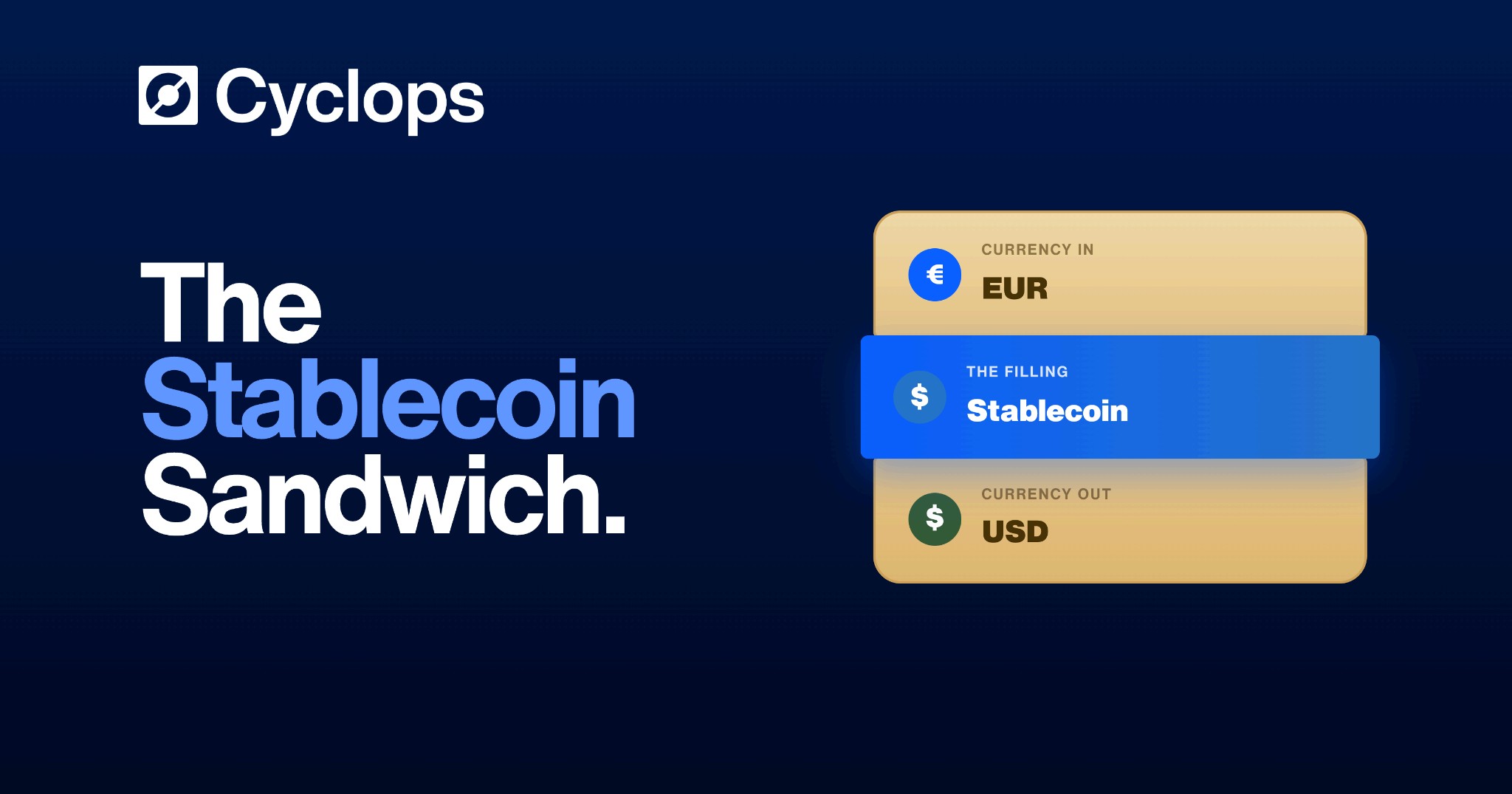
The concept is straightforward. A sender initiates a payment in their currency. In the middle, stablecoin rails handle the settlement: moving money on-chain in seconds rather than days. On the other end, the recipient receives local currency. The stablecoin is the filling and the currency is the bread on both sides.
The sender never holds a stablecoin. The recipient never holds a stablecoin. Neither party needs a crypto wallet, a blockchain account or any knowledge of how the infrastructure works.
They just send and receive money faster and cheaper than before.
Where It's Already Happening
The stablecoin sandwich is already running at scale. Revolut has processed over $1.2 billion in stablecoin transfers on Polygon — users in the UK and Europe sending money across borders with near-instant settlement and fees at fractions of a penny. Tazapay, a B2B payments platform operating in 173 countries, processed $687 million on stablecoin rails in January 2026 alone. In both cases the stablecoin was invisible. Recipients received local currency, users just experienced faster, cheaper cross-border payments.
Real-world stablecoin payment volumes doubled in 2025 to $400 billion, with 60% of that volume driven by B2B payments. The growth isn't coming from consumers who want to pay in crypto. It's coming from businesses and payments companies that are searching for faster, cheaper and more reliable settlement.
Why This Matters for Payments Companies
The most common reason PSPs hesitate on stablecoins is the assumption that adding them means adding complexity — explaining crypto to merchants, rebuilding workflows, introducing something unfamiliar to customers who didn't ask for it.
The stablecoin sandwich sidesteps all of that. Payments that once took one to five business days settle in seconds. Costs that stacked up across correspondent banking chains drop significantly on stablecoin rails. Those gains show up in faster settlement, lower fees and broader corridor coverage, without changing a single thing about the experience a merchant or customer sees.
For PSPs, that's the point. Better infrastructure with the same experience on the outside.
How Cyclops Enables This
Cyclops was built specifically for this. Our platform handles the currency-to-stablecoin conversion, the on-chain settlement and the conversion back to local currency, so the payments company never touches crypto and neither do their merchants or customers. On-ramps, custody, compliance screening, liquidity and off-ramps are all handled within the platform, through one integration.
The complexity is abstracted away and the improvements show up on the other end.